Arriving back in Katoomba after a month of summer in Canada, I'm interested in how many signs of impending spring there are already. Everywhere between Sydney and here, the wattles (Acacia spp.) are in flower. Not the Acacia baileyana in our backyard however. It was planted in an area of full shade at this time of the year, so although it is in bud, there's no fountain of tiny yellow bubbles to look at quite yet. Sunshine and warmer temperatures are forecast for this week, which may spur it into bloom.
A clump of snowflakes has, however, opened in our absence, and there are some narcissus that have sprung up in the vacant lot next door, which I might rescue when they've finished blooming. There are blades of other bulbs in the small front garden. Some I think are going to be hyacinths. We shall see.
Saturday, 4 August 2007
Wednesday, 20 June 2007
Winter Solstice
And it's brutally cold here in the mountains. Daytime temperatures are no more than a degree above the night-time ones of 3° or 4°C. We haven't yet got our house in order - no curtains on the windows, for instance, so it's hard to keep the interior warm. The Australian defiance of the fact that they have a winter at all doesn't help either. Windows are single-glazed, construction design and materials don't include insulation, and heating systems are not as advanced as they are in Canada with its longer winter. My favourite accessories right now are a pair of Peruvian-patterned woolly socks, knitted by Kathy Wilson, late of Langley, in a combination of wool from our sheep and fleece from her llamas.
Sunday, 17 June 2007
Winter blooms

It's less than a week to the solstice and I'm amazed at the number of plants that are bursting into bloom already. I expected the sasanqua camellias, which I've already mentioned, but I didn't expect them to keep flowering for so long. Now they are being joined by other plants, some of which seem logical at this time of year, like heath and mimosa (or wattle as the Aussies call it), and others quite unexpected like the kniphofia (red hot poker) in the photo and bergenia (pigsqueak). Japonica camellias are also beginning to bloom, though I did hear someone say that they are early this year. Lavender, particularly Lavandula stoechas, doesn't seem to have stopped flowering at all, even though the weather has been cold and stormy for the last week with temperatures comparable to a Vancouver winter, ie. not reaching double digits in daytime and close to zero at night. I've also noticed occasional salvia, penstemon and osteospermum blooms in my neighbourhood.
Monday, 4 June 2007
Educational options
In yesterday's mail came a brochure for the local TAFE (Technical and Further Education) institute. Oh goody, she thinks, maybe I'll take a course in Australian politics or pick up another language.
Well.....no.
They are all courses for industry, inviting me to sign up for Driving a Mobile Crane over 20 tonnes (cost: $1885) or perhaps Bushfire Protection Sprinkler Systems ($850). I'm not really tempted by Coffee Preparation ($199) or Safe Working at Heights ($215) or Brazilian Waxing ($135). And Gel Nail Enhancement ($168) is a post trade course so I'm not eligible.
But wait! There's a listing for Horticulture. Maybe this will be for me?
Two courses are offered:
One is Chainsaw Operations (Level 1).
The other is Chainsaw Operations (Level 2).
Uh-huh!
I think I'll settle for Vegetable Carving ($440).
Well.....no.
They are all courses for industry, inviting me to sign up for Driving a Mobile Crane over 20 tonnes (cost: $1885) or perhaps Bushfire Protection Sprinkler Systems ($850). I'm not really tempted by Coffee Preparation ($199) or Safe Working at Heights ($215) or Brazilian Waxing ($135). And Gel Nail Enhancement ($168) is a post trade course so I'm not eligible.
But wait! There's a listing for Horticulture. Maybe this will be for me?
Two courses are offered:
One is Chainsaw Operations (Level 1).
The other is Chainsaw Operations (Level 2).
Uh-huh!
I think I'll settle for Vegetable Carving ($440).
Thursday, 24 May 2007
Cryptic Comment
For as long as I can remember I've been a crossword addict, graduating from the standard "find the synonym" type through the Saturday New York Times ones with their quirky themes to the London Sunday Times cryptics. In Canada, The Sun newspaper obligingly runs the latter two every weekend. Although I didn't buy the paper (too much newsprint to recycle) my dear friend Basil, lifelong librarian that he is, has been faithfully clipping and sending me my weekly fix for some years, and continues to do so even though I'm now on the other side of the Pacific Ocean.
Meanwhile, I've discovered that The Australian newspaper runs three crosswords in their Saturday edition: an easy synonym type, and two challenging cryptics, one obviously local and the other an import from the UK.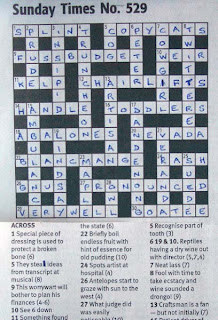 The paper even offers a free Australian dictionary as a prize for the first correct solution to the local cryptic opened each week, so of course if I can fill in all the squares I send mine off with hope that I'll be the lucky winner. After more than 25 years of living overseas, I'm quite proud of myself when I do complete one of these, as there is always at least one answer relating to an Australian placename, animal, politician or celebrity. In the example here, 17 Down is the name of a town in the state of Victoria, which I only remembered because it appears in a poem I read in high school. 6 Down, 19 Down and 10 Across spell out the full name of an Australian film director. OK, for once it's somebody with an international reputation, but who knew his middle name was Lindsay?? I think I ought to get extra credit for effort in these circumstances, but of course I never win. So far anyway. Michael thinks that by the time I do, I'll have spent enough money on stamps to have bought the darned dictionary several times over. He just doesn't understand the thrill of the pursuit!
Meanwhile, I've discovered that The Australian newspaper runs three crosswords in their Saturday edition: an easy synonym type, and two challenging cryptics, one obviously local and the other an import from the UK.
 The paper even offers a free Australian dictionary as a prize for the first correct solution to the local cryptic opened each week, so of course if I can fill in all the squares I send mine off with hope that I'll be the lucky winner. After more than 25 years of living overseas, I'm quite proud of myself when I do complete one of these, as there is always at least one answer relating to an Australian placename, animal, politician or celebrity. In the example here, 17 Down is the name of a town in the state of Victoria, which I only remembered because it appears in a poem I read in high school. 6 Down, 19 Down and 10 Across spell out the full name of an Australian film director. OK, for once it's somebody with an international reputation, but who knew his middle name was Lindsay?? I think I ought to get extra credit for effort in these circumstances, but of course I never win. So far anyway. Michael thinks that by the time I do, I'll have spent enough money on stamps to have bought the darned dictionary several times over. He just doesn't understand the thrill of the pursuit!
Tuesday, 15 May 2007
Men in Ties
Earlier this week, the federal government brought down its budget for this election year. We watched the treasurer's speech on TV and, although I did listen, my lasting impression was a visual one. Every man present, whether on the government or opposition benches, seemed to be wearing a navy blue suit. Most were plain cloth, though a few members were daring enough to choose a pinstriped version. With the suit, all had chosen a diagonally striped tie. The biggest diversion from this uniform lay in the colour of the stripes.
Now, I've always maintained that a man's tie fulfils the same function for him as a woman's jewellery does for her: it reveals something of the personality of the wearer. Think chunky brass and and copper versus a sedate string of pearls. I personally have a penchant for earrings in leaf shapes. But, clearly, these Australian politicians are playing their cards close to their conservative chests. Where are the cartoon character ties, the little aeroplanes, golf clubs or palm trees? I know they are available in the shops as our daughter has bought Michael a selection of interesting designs over the years. One of her inspired choices even looks at first glance like the standard diagonal, but on closer inspection the stripes turn out to be parallel rows of tiny snails.
Having noted this peculiar symptom among politicians, I'm now seeing it in other professions. Television newsreaders also wear the predictable diagonal, although one at least has a model in irridescent purple stripes on a dark blue background. (By contrast, the women newsreaders wear the most bizarre fashions, often with assertive lapels or an assortment of net and frills around the neckline.) A panel of five sportscasters included three diagonal tie wearers. The remaining two, bucking the trend, had opted for circles instead, one of which might just possibly have been little soccer balls, but the camera never provided a close-up, so I can only hope.
Now, I've always maintained that a man's tie fulfils the same function for him as a woman's jewellery does for her: it reveals something of the personality of the wearer. Think chunky brass and and copper versus a sedate string of pearls. I personally have a penchant for earrings in leaf shapes. But, clearly, these Australian politicians are playing their cards close to their conservative chests. Where are the cartoon character ties, the little aeroplanes, golf clubs or palm trees? I know they are available in the shops as our daughter has bought Michael a selection of interesting designs over the years. One of her inspired choices even looks at first glance like the standard diagonal, but on closer inspection the stripes turn out to be parallel rows of tiny snails.

Having noted this peculiar symptom among politicians, I'm now seeing it in other professions. Television newsreaders also wear the predictable diagonal, although one at least has a model in irridescent purple stripes on a dark blue background. (By contrast, the women newsreaders wear the most bizarre fashions, often with assertive lapels or an assortment of net and frills around the neckline.) A panel of five sportscasters included three diagonal tie wearers. The remaining two, bucking the trend, had opted for circles instead, one of which might just possibly have been little soccer balls, but the camera never provided a close-up, so I can only hope.

More on camellias


Camellia sasanqua began flowering in numerous local gardens over a month ago. It is now in full bloom and very eye-catching. At Blackheath in the grounds of the community centre is this vigorous if slightly straggly example, thriving with seemingly little care. (Thank you brother-in-law Paul for having your camera handy). Pink forms like this are the most ubiquitous, but a neighbour of ours has a particularly attractive bi-color one with white petals dipped in raspberry pink. In Vancouver's persistent winter rains, the flowers so often turn sodden and brown within hours of opening, but here in Australia's dry climate, they have a much longer shelf life.
Subscribe to:
Posts (Atom)