Wednesday, 15 August 2012

Success with vegetables

Our new vegetable patch has begun to be productive, with green onions, peas, beans and broccoli all demanding to be harvested.


The raised beds are proving very successful.


 You can almost see that patch of corn at the back getting taller every day.


In fact, since I took these photos the beans have sprung up the fence and are waving above the top rail, and the lettuce-leaf basil has finally decided that it is hot enough to begin to grow. Only our second crop of lettuce has stalled in the heat and may have to be replanted when the temperature drops back to our normal cool.


The view from my desk into the back garden has changed in two years from this


to this:


Of course, there's still a lot to do. That patch of grass on the left has to be turned into more garden beds, and there is still quite a bit of brown earth elsewhere waiting for the right plants to cover it. However, brown earth itself is a great improvement over buttercups and other weeds that were providing much of the green in the early photo.

Success with vegetables

Our new vegetable patch has begun to be productive, with green onions, peas, beans and broccoli all demanding to be harvested.


The raised beds are proving very successful.


 You can almost see that patch of corn at the back getting taller every day.


In fact, since I took these photos the beans have sprung up the fence and are waving above the top rail, and the lettuce-leaf basil has finally decided that it is hot enough to begin to grow. Only our second crop of lettuce has stalled in the heat and may have to be replanted when the temperature drops back to our normal cool.

The view from my desk into the back garden has changed in two years from this


to this:


Of course, there's still a lot to do. That patch of grass on the left has to be turned into more garden beds, and there is still quite a bit of brown earth elsewhere waiting for the right plants to cover it. However, brown earth itself is a great improvement over buttercups and other weeds that were providing much of the green in the early photo.

Tuesday, 7 August 2012

More plants

It's hydrangea time. I'm becoming more addicted to hydrangeas since I discovered how many alternatives to coarse-leaved mopheads there are in the family. I have a young H. serrata hybrid called 'Waterfall' that has put out one bloom this year.


As it ages, the greenish-white petals are slowly becoming suffused with ice-blue. The leaves are rather coarse but they are a good sharp green that sets off the flowers very nicely. If it blooms more profusely next year, I think it will earn its place.


A close relative of 'Waterfall' is still in a pot, but it too has produced one flower. I'm not sure I like the colour...


because it's too lush a pink, especially for a plant called 'Purple Tiers'. I think I'll move it to a larger pot, add some aluminum sulphate to push it towards blue tones, and see what happens next year before giving it garden space.


My tree hydrangea that I hope will eventually dominate the northeast garden bed is, however, living up to expectations. I love the crisp look of the flowerheads...


 ...and the big velvet-textured leaves.


None of these new additions has supplanted 'Beni-gaku' as my favourite, and that's not surprising when its combination of beautiful foliage and delicate flowers is so exquisite.


Elsewhere, a couple of thistle relatives are looking dramatic in the dry part of the front garden. One is Eryngium giganteum aka Miss Wilmott's Ghost.


Miss Wilmott, a rich, eccentric Englishwoman, so liked this plant that she used to secretly scatter seed in other people's gardens. Its mysterious arrival following a visit from her led to its unusual nickname.


On the other side of the front path competition comes from Echinops ritro 'Taplow Blue'. Both plants have a metallic sheen that makes them almost pulsate in the summer sunshine.


What they both need is more companions to cover the bare earth at their feet. I'm still contemplating candidates for that job.

Meanwhile my lavender hedge in front of them has become a reality. I've just clipped off the dead flowers and, with the exception of a couple of plants under the canopy of the street maple, they've now grown together, just as I had hoped, to form a continuous line along the sidewalk.


 Slowly I am making progress.


More plants

It's hydrangea time. I'm becoming more addicted to hydrangeas since I discovered how many alternatives to coarse-leaved mopheads there are in the family. I have a young H. serrata hybrid called 'Waterfall' that has put out one bloom this year.


As it ages, the greenish-white petals are slowly becoming suffused with ice-blue. The leaves are rather coarse but they are a good sharp green that sets off the flowers very nicely. If it blooms more profusely next year, I think it will earn its place.

A close relative of 'Waterfall' is still in a pot, but it too has produced one flower. I'm not sure I like the colour...


because it's too lush a pink, especially for a plant called 'Purple Tiers'. I think I'll move it to a larger pot, add some aluminum sulphate to push it towards blue tones, and see what happens next year before giving it garden space.

My tree hydrangea that I hope will eventually dominate the northeast garden bed is, however, living up to expectations. I love the crisp look of the flowerheads...


 ...and the big velvet-textured leaves.

None of these new additions has supplanted 'Beni-gaku' as my favourite, and that's not surprising when its combination of beautiful foliage and delicate flowers is so exquisite.


Elsewhere, a couple of thistle relatives are looking dramatic in the dry part of the front garden. One is Eryngium giganteum aka Miss Wilmott's Ghost.


Miss Wilmott, a rich, eccentric Englishwoman, so liked this plant that she used to secretly scatter seed in other people's gardens. Its mysterious arrival following a visit from her led to its unusual nickname.

On the other side of the front path competition comes from Echinops ritro 'Taplow Blue'. Both plants have a metallic sheen that makes them almost pulsate in the summer sunshine.


What they both need is more companions to cover the bare earth at their feet. I'm still contemplating candidates for that job.
Meanwhile my lavender hedge in front of them has become a reality. I've just clipped off the dead flowers and, with the exception of a couple of plants under the canopy of the street maple, they've now grown together, just as I had hoped, to form a continuous line along the sidewalk.


 Slowly I am making progress.

Wednesday, 11 July 2012

Poppies and their Partners

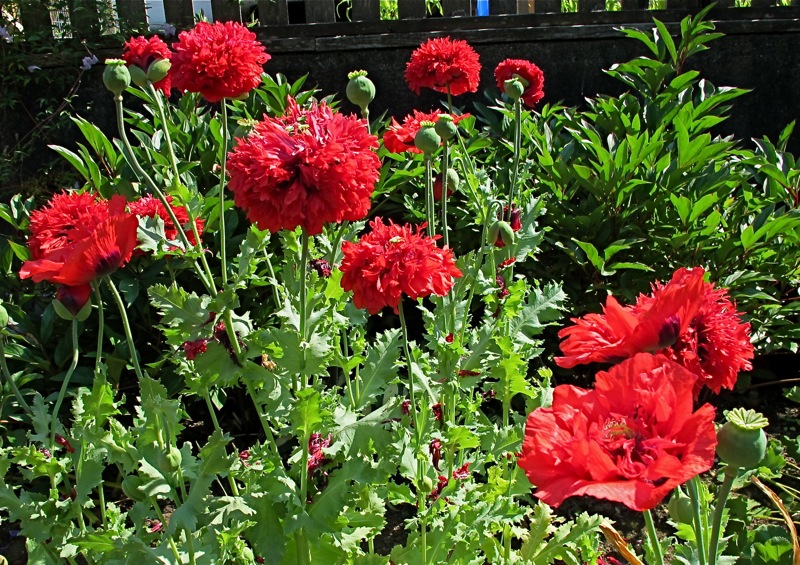
In spring I scattered poppy seeds in various bare patches to fill in the beds while I went about selecting more permanent plants. They have come up in a variety of doubles and singles, all of them attractive.

Although I didn't plan it that way, all the poppies sown among my scarlet peonies that flowered last month are also red.


Not far away, another group has all opened baby pink.


And there are also some lovely dark raspberry singles.


I get contrasting colour from low-growing Geranium 'Rozanne' next to the red poppies,


...and am just waiting for two pale yellow partners to open: Anthemis 'Sauce Hollandaise' and a species hollyhock.


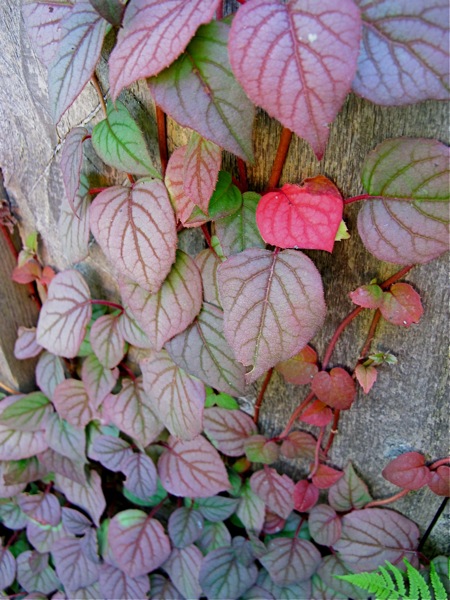
Meanwhile on the fence Schizophragma hydrangeoides continues to impress me with the colour of its leaves.


Another impressive sight is a single Allium giganteum as tall as I am. The bulbs are rather expensive, but I think I'll have to indulge in a few more to accompany this one next year.


Beyond the flower garden, the vegetable plots are filling up.


In the foreground arugula is already flowering, but we're leaving it so that we can collect some seed for another crop. Soon we will have peas and beans climbing that back fence and screening the unattractive lane behind.

Poppies and their Partners

In spring I scattered poppy seeds in various bare patches to fill in the beds while I went about selecting more permanent plants. They have come up in a variety of doubles and singles, all of them attractive.
Although I didn't plan it that way, all the poppies sown among my scarlet peonies that flowered last month are also red.


Not far away, another group has all opened baby pink.


And there are also some lovely dark raspberry singles.


I get contrasting colour from low-growing Geranium 'Rozanne' next to the red poppies,


...and am just waiting for two pale yellow partners to open: Anthemis 'Sauce Hollandaise' and a species hollyhock.

Meanwhile on the fence Schizophragma hydrangeoides continues to impress me with the colour of its leaves.


Another impressive sight is a single Allium giganteum as tall as I am. The bulbs are rather expensive, but I think I'll have to indulge in a few more to accompany this one next year.


Beyond the flower garden, the vegetable plots are filling up.


In the foreground arugula is already flowering, but we're leaving it so that we can collect some seed for another crop. Soon we will have peas and beans climbing that back fence and screening the unattractive lane behind.

Monday, 2 July 2012

Defiant flowers

June has been such a rainy, grey month this year that everyone is calling it Juneuary. Nevertheless, flowers continue to open on their own internal calendar, probably hoping for  change just like the rest of us.

The red peonies I mentioned in an earlier post, were bravely upright mid-month before their heads filled with so much rainwater that they all flopped.


I'm quite pleased with the way they are blending with their companions...


...a Nectaroscordum siculum and the purple-flushed leaves of Ligularia. In the background is Sanguisorba with matching red bottlebrushes.


On the wall behind this explosion of colour, the seedheads of pretty Clematis 'Willy' whose flowers I mentioned in spring are hardly noticeable, which is a pity. In future years, as the clematis bulks up, I hope there will be enough of them to have more impact.


The peony flowers are a mixture of double and semi-double with a few almost single. Although with many plants I prefer the single forms, in this case I feel there's nothing quite as sumptuous as a double peony.


My photograph doesn't do it justice as it's a darker, richer red than this. I've done some tinkering like adjusting the black level but just can't get it more true to life.


Geranium x magnificum, however, is living up to its name and all that saturated blue-purple is legitimate, untouched by photoshop.


My shady corner is beginning to fill in now.


Left to right are Hydrangea nigra with the black stems, Hosta 'Krossa Regal', my favourite hosta, the airy cream flowers and purple foliage of Heuchera 'Stormy Seas', and Schizophragma hydrangeoides climbing up the fence behind. The little foreground plant is shrubby Clematis ochroleuca. I'm not sure why the Schizophragma leaves are so red unless they are responding to the rusty hues of my metal rooster. They are supposed to be silvery green, but as long as the plant seems healthy, I'm perfectly happy with the current colour.


I've since added a lovely long-spurred Aquilegia to this composition.


The blurry foliage behind it is Japanese painted fern, but the Aquilegia's own foliage is a similar blend of sea-green and purple.


Another shade plant a little further long in the same bed is Astrantia 'Shaggy', a really nice plant for brightening up a dark area.


By mid-month the roses were beginning to open. 'Ghislaine de Féligonde' was full of buds,


and I eagerly awaited the first flower.


Also in the front garden is delicate Rosa 'Dupontii'.


Blue-grey foliage, pink buds and pristine white flowers, fragrant and still faintly tipped with pink, make this plant special. Later, I'll get red rosehips for an autumn display.


In the back garden 'Rosa Mundi' is much less subtle.


It smells as a rose should smell, and is highly popular with the bees. If I'm not mistaken, I unexpectedly caught a blue orchard bee approaching another of the flowers late on a rare sunny afternoon.