Wednesday, 22 January 2020

New Year's Resolution

The last several months of 2019 were a busy time for me and so, although I took photos as the garden moved from the bright colours of summer into the jewel tones of fall, I never found the time to post them.

My resolution for 2020 is to keep this record going with at least one post every month. We shall see.


A heavy snowfall to start the year off left little to see.


Still, I was surprised at how well the oak leaf hydrangea weathered its load, considering that it hadn't dropped its autumn leaves. Their russet tints made a nice contrast with their caps of snow at a time when any colour at all is welcome.


Of course, the snow only enhanced structural plants like our ancient pear.


Without the snow, its coating of lime-green moss and blue-grey lichen continues to keep it attractive, particularly to birds like juncos and chickadees who pick their way through the branches in search of edible tidbits.


My homemade chickadee nesting box on the trunk has only once been occupied in five years, but I put it out every winter in hopes of new residents.


Along the front of the house, we piled snow from the sidewalk against the bottom of the lavender hedge to try to support the somewhat brittle stems. They will need an additional pruning this spring to bring them back to a compact shape.


Rather to my surprise, the stems of Sedum 'Autumn Joy' in the bed behind the lavender are demonstrating an unsuspected sturdiness. This is such a good plant for year-round value. Here it is last fall with leaves turning yellow and flowers deepening from sultry pink to dark crimson.


The flowers are a rich brown now, nothing special at any other time of year but a pleasing contrast to so much winter grey and white.


Fortunately, the weather has warmed in the last few days and the snow has melted rapidly to reveal signs of spring already. Winter aconites (Eranthis hyemalis) are always first to bloom, ahead of even the snowdrops. This is not really surprising once you know that "hyemalis" means "of winter". (When I studied Latin in school, I had no idea what an asset it would be to me as a gardener later in life.)


There are buds on most of the hellebores too, though H. 'Jacob', the only one that has opened so far, has been stripped of every bloom by slugs. Still there are other, more resistant ones on the verge of flowering, like 'Pink Frost' and a plant that I bought, sad and unlabelled in a big box store clearance, that is responding well to better conditions. I think might be 'Jade Tiger'.


Hellebore 'Pink Frost'


Hellebore 'Jade Tiger'?


Perhaps the most consistently satisfying plant in this gloomy season has been Mahonia 'Winter Sun'.

When it first began to bloom in late October, my 'Lykkefund' rose was wreathing it in festive red berries.


The flowers are falling now, but it's still a cheerful sight and still draws an occasional hummingbird to siphon off the last of its nectar.


New Year's Resolution

The last several months of 2019 were a busy time for me and so, although I took photos as the garden moved from the bright colours of summer into the jewel tones of fall, I never found the time to post them.
My resolution for 2020 is to keep this record going with at least one post every month. We shall see.

A heavy snowfall to start the year off left little to see.


Still, I was surprised at how well the oak leaf hydrangea weathered its load, considering that it hadn't dropped its autumn leaves. Their russet tints made a nice contrast with their caps of snow at a time when any colour at all is welcome.


Of course, the snow only enhanced structural plants like our ancient pear.


Without the snow, its coating of lime-green moss and blue-grey lichen continues to keep it attractive, particularly to birds like juncos and chickadees who pick their way through the branches in search of edible tidbits.


My homemade chickadee nesting box on the trunk has only once been occupied in five years, but I put it out every winter in hopes of new residents.

Along the front of the house, we piled snow from the sidewalk against the bottom of the lavender hedge to try to support the somewhat brittle stems. They will need an additional pruning this spring to bring them back to a compact shape.


Rather to my surprise, the stems of Sedum 'Autumn Joy' in the bed behind the lavender are demonstrating an unsuspected sturdiness. This is such a good plant for year-round value. Here it is last fall with leaves turning yellow and flowers deepening from sultry pink to dark crimson.


The flowers are a rich brown now, nothing special at any other time of year but a pleasing contrast to so much winter grey and white.

Fortunately, the weather has warmed in the last few days and the snow has melted rapidly to reveal signs of spring already. Winter aconites (Eranthis hyemalis) are always first to bloom, ahead of even the snowdrops. This is not really surprising once you know that "hyemalis" means "of winter". (When I studied Latin in school, I had no idea what an asset it would be to me as a gardener later in life.)


There are buds on most of the hellebores too, though H. 'Jacob', the only one that has opened so far, has been stripped of every bloom by slugs. Still there are other, more resistant ones on the verge of flowering, like 'Pink Frost' and a plant that I bought, sad and unlabelled in a big box store clearance, that is responding well to better conditions. I think might be 'Jade Tiger'.

Hellebore 'Pink Frost'


Hellebore 'Jade Tiger'?

Perhaps the most consistently satisfying plant in this gloomy season has been Mahonia 'Winter Sun'.
When it first began to bloom in late October, my 'Lykkefund' rose was wreathing it in festive red berries.


The flowers are falling now, but it's still a cheerful sight and still draws an occasional hummingbird to siphon off the last of its nectar.


Friday, 16 August 2019

The Highlights of Summer


Now that the garden is approaching maturity, I find I have less to write about that I haven't covered in previous years. As a result, I'm only now gathering a few images from the last months that have struck me as worth a second, or even a third, look.


I've always enjoyed the brief but glamorous display of an unnamed red peony that predates our arrival. I moved it a few years back into more sun and more recently planted two Ranunculus 'Flore Pleno' beside it. The contrasting forms and colours made it a winning combination in late May.


Even after the peony was spent, the little white buttons of the Ranunculus kept on sparkling well into June.


A new bulb for me this year was Allium atropurpureum, actually darker than it looks in my photo. I've planted it around Salix lapponum, whose silver foliage sets off the wine-red flowers. I like the effect enough to plan on buying more of it.


Disporum 'Night Heron' was too small and innocuous to make much of an impact last year, but this year it has grown to more than a metre. It's a subtle addition to the shady back of the garden, but the  the drooping cream bells and unusual pleated leaves with their inky overtones are worth lingering to appreciate.


Anemone 'Wild Swan' goes from strength to strength. The crisp white face of the flowers brings a reminder of spring into the middle of summer, and the surprise of their lavender reverse is a nice bonus.


It seems to remain compact where it has more space and stretches readily to compete with other perennials when they crowd in around it. Here it's competing with a blue monkshood, purple Monarda 'Donnerwolke' and the dark brown leaves of self-seeding Angelica gigas 'Vicar's Mead'


Clematis 'Durandii' has never been better than this year. The buds looked like little snakeheads as they threaded their way through my oak leaf hydrangea,


... and the flower display was spectacular.


Tucked away in the shade, Roscoea cautleyoides 'Alba' has only produced a single flower stem in the several years I've had it, but it too has rewarded me this year with several of its strange, fragile flowers. It disappears so completely in winter that I have to mark its place with the top ring of a broken clay pot or I'm likely to trample it to death during early spring clean-up.


A year cannot go by without a mention of the roses. Their flowers opened early, before the end of May, and they faded quickly, but what they lacked in longevity they made up for in wealth of bloom.


Rosa pimpinellifolia


'Lykkefund'


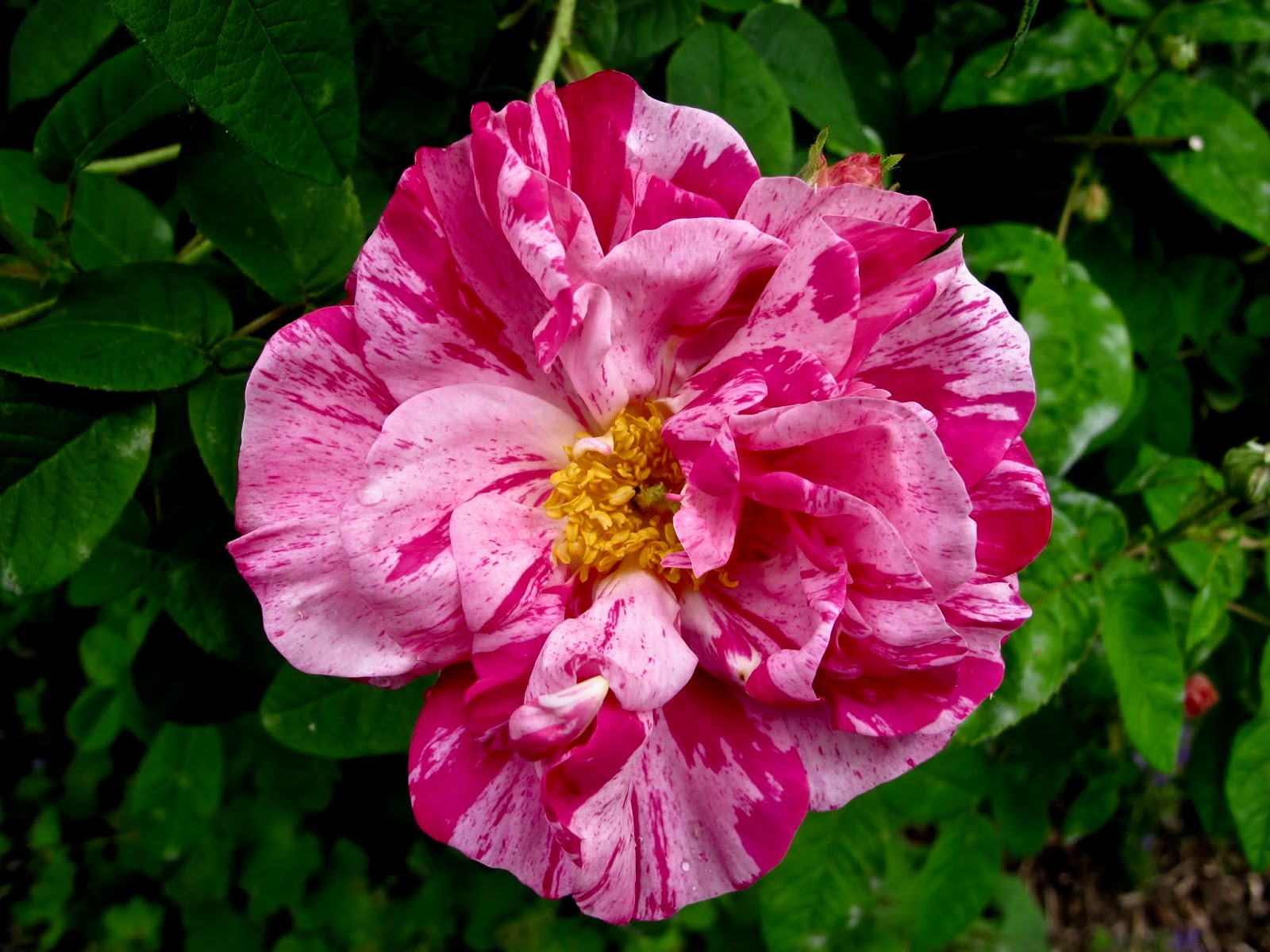
'Rosa Mundi'


'Ghislaine de Féligonde'


A special mention this year for Rosa 'Bill Forsyth', named by me for the man who bred it and who gave me a plant that I later passed on to Free Spirit Nursery, who gave me back a young specimen this year. It has the blue-grey foliage of its parent Rosa glauca, but a larger, more vibrant pink flower. Bill is no longer with us, but I hope his rose will keep alive the memory of a quiet, modest man whose gardening skills and knowledge were legendary among those of us who value such things.


'Bill Forsyth'


The Highlights of Summer

Now that the garden is approaching maturity, I find I have less to write about that I haven't covered in previous years. As a result, I'm only now gathering a few images from the last months that have struck me as worth a second, or even a third, look.

I've always enjoyed the brief but glamorous display of an unnamed red peony that predates our arrival. I moved it a few years back into more sun and more recently planted two Ranunculus 'Flore Pleno' beside it. The contrasting forms and colours made it a winning combination in late May.


Even after the peony was spent, the little white buttons of the Ranunculus kept on sparkling well into June.

A new bulb for me this year was Allium atropurpureum, actually darker than it looks in my photo. I've planted it around Salix lapponum, whose silver foliage sets off the wine-red flowers. I like the effect enough to plan on buying more of it.


Disporum 'Night Heron' was too small and innocuous to make much of an impact last year, but this year it has grown to more than a metre. It's a subtle addition to the shady back of the garden, but the  the drooping cream bells and unusual pleated leaves with their inky overtones are worth lingering to appreciate.


Anemone 'Wild Swan' goes from strength to strength. The crisp white face of the flowers brings a reminder of spring into the middle of summer, and the surprise of their lavender reverse is a nice bonus.


It seems to remain compact where it has more space and stretches readily to compete with other perennials when they crowd in around it. Here it's competing with a blue monkshood, purple Monarda 'Donnerwolke' and the dark brown leaves of self-seeding Angelica gigas 'Vicar's Mead'


Clematis 'Durandii' has never been better than this year. The buds looked like little snakeheads as they threaded their way through my oak leaf hydrangea,


... and the flower display was spectacular.


Tucked away in the shade, Roscoea cautleyoides 'Alba' has only produced a single flower stem in the several years I've had it, but it too has rewarded me this year with several of its strange, fragile flowers. It disappears so completely in winter that I have to mark its place with the top ring of a broken clay pot or I'm likely to trample it to death during early spring clean-up.


A year cannot go by without a mention of the roses. Their flowers opened early, before the end of May, and they faded quickly, but what they lacked in longevity they made up for in wealth of bloom.

Rosa pimpinellifolia
'Lykkefund'
'Rosa Mundi'
'Ghislaine de Féligonde'

A special mention this year for Rosa 'Bill Forsyth', named by me for the man who bred it and who gave me a plant that I later passed on to Free Spirit Nursery, who gave me back a young specimen this year. It has the blue-grey foliage of its parent Rosa glauca, but a larger, more vibrant pink flower. Bill is no longer with us, but I hope his rose will keep alive the memory of a quiet, modest man whose gardening skills and knowledge were legendary among those of us who value such things.

'Bill Forsyth'