Thursday, 26 November 2009

Echuca to Rutherglen

November 19

We woke at 7:00 to a sky the colour of dirty dishwater. The temperature was already climbing through the 30's. By 8:30 the caravan park was already emptying. People were anxious to get their travelling done early, before the predicted 40ºC.
All the radio stations were broadcasting the same news: record high temperatures across the southeast of the continent, extreme fire ban, stay indoors if possible, otherwise seek out malls and other air-conditioned public places to escape the heat.
We set off eastwards along the Murray River, driving slowly and drinking copious amounts of water. The air became denser and the sky a peculiar pewter - very bright, but sucking all the colour out of the landscape. All my photos from this day have a bleached-out look to them.
We passed through parched fields,


with a few deserted old buildings by the roadside from time to time.


At Lake Mulwala with its flooded trees, we felt like characters in a science fiction movie, awaiting the apocalypse.


It was too hot for our usual picnic lunch so we ate in a diner in the dead-end town of Katamatite, served by a plump, impassive girl who might well have been an alien in disguise.

It was a relief to reach Rutherglen, a charming little historic town


in the heart of a wine-growing area that is particularly famous for its fortified wines:


We found a shady spot in their caravan park and felt slightly better after a cold shower, even though the heat stayed intense for the rest of the day. When I re-filled our water bottle at the tap, I was approached by a couple of magpies gasping in the heat. I put a little water in a plastic cup for them.


Later in the afternoon, we braved the heat to stroll through the town. It had a great Echium growing through a fence,


and a great secondhand bookstore.

Echuca to Rutherglen

November 19

We woke at 7:00 to a sky the colour of dirty dishwater. The temperature was already climbing through the 30's. By 8:30 the caravan park was already emptying. People were anxious to get their travelling done early, before the predicted 40ºC.
All the radio stations were broadcasting the same news: record high temperatures across the southeast of the continent, extreme fire ban, stay indoors if possible, otherwise seek out malls and other air-conditioned public places to escape the heat.
We set off eastwards along the Murray River, driving slowly and drinking copious amounts of water. The air became denser and the sky a peculiar pewter - very bright, but sucking all the colour out of the landscape. All my photos from this day have a bleached-out look to them.
We passed through parched fields,


with a few deserted old buildings by the roadside from time to time.


At Lake Mulwala with its flooded trees, we felt like characters in a science fiction movie, awaiting the apocalypse.


It was too hot for our usual picnic lunch so we ate in a diner in the dead-end town of Katamatite, served by a plump, impassive girl who might well have been an alien in disguise.

It was a relief to reach Rutherglen, a charming little historic town


in the heart of a wine-growing area that is particularly famous for its fortified wines:


We found a shady spot in their caravan park and felt slightly better after a cold shower, even though the heat stayed intense for the rest of the day. When I re-filled our water bottle at the tap, I was approached by a couple of magpies gasping in the heat. I put a little water in a plastic cup for them.


Later in the afternoon, we braved the heat to stroll through the town. It had a great Echium growing through a fence,


and a great secondhand bookstore.

Wednesday, 18 November 2009

Bendigo to Echuca


November 18


The birthday of our favourite daughter - Happy Birthday, Sarah Jane!

On our way out of town we stopped at Bendigo Pottery, probably the most famous pottery in Australia. They make lovely earthenware crocks, jugs and dishes in an old-fashioned country-kitchen style. We bought a butter dish, not an easy object to find in the modern kitchen decor shop.
There was also a small metalworks gallery in the complex with lovely sculptures outside. We would have liked to buy one, but it wouldn't fit in the van.


It was just a short drive through golden hayfields to Echuca on the Murray River.


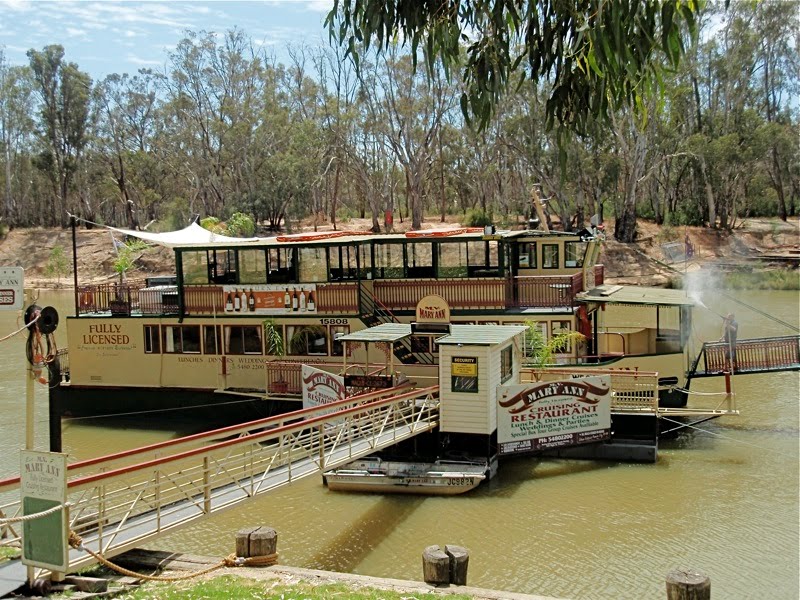
Echuca is famous for its collection of paddlewheelers and, despite the river being at an all-time low, several were still plying the waters.


A river red gum on the bank showed how high the waters had come in some of the years before the current drought.


With the temperature in the high thirties, everyone in the caravan park was seeking even the most minimal shade.


We didn't feel like cooking, and treated ourselves to a surprisingly good dinner in the Star Hotel's bistro.


Afterwards, we walked back along the river


passing a spot where numerous cockatoos were gathering on the bank. You can see from the exposed roots of the river gums how low the water level has fallen in this once mighty river, Australia's largest.


Judging by the increasing volume of squawking throughout the evening, this was a popular roosting place for the cockies.

We slept amazingly well, considering that the temperature did not fall below 30ºC all night.

Bendigo to Echuca


November 18


The birthday of our favourite daughter - Happy Birthday, Sarah Jane!

On our way out of town we stopped at Bendigo Pottery, probably the most famous pottery in Australia. They make lovely earthenware crocks, jugs and dishes in an old-fashioned country-kitchen style. We bought a butter dish, not an easy object to find in the modern kitchen decor shop.
There was also a small metalworks gallery in the complex with lovely sculptures outside. We would have liked to buy one, but it wouldn't fit in the van.


It was just a short drive through golden hayfields to Echuca on the Murray River.


Echuca is famous for its collection of paddlewheelers and, despite the river being at an all-time low, several were still plying the waters.


A river red gum on the bank showed how high the waters had come in some of the years before the current drought.


With the temperature in the high thirties, everyone in the caravan park was seeking even the most minimal shade.


We didn't feel like cooking, and treated ourselves to a surprisingly good dinner in the Star Hotel's bistro.


Afterwards, we walked back along the river


passing a spot where numerous cockatoos were gathering on the bank. You can see from the exposed roots of the river gums how low the water level has fallen in this once mighty river, Australia's largest.


Judging by the increasing volume of squawking throughout the evening, this was a popular roosting place for the cockies.

We slept amazingly well, considering that the temperature did not fall below 30ºC all night.

Bendigo

Leaving Daylesford, I admired their fountain, which looked as if it had been sponsored by a hairdressing salon.


One of the first things I did thereafter was get a haircut. Auto-suggestion, perhaps?

It wasn't very far to Bendigo, a large prosperous town that we'd liked on an earlier visit about 10 years ago. Bendigo was the centre of some of the richest goldfields in Victoria at the turn of last century, and consequently has broad avenues and grand public buildings.


as well as some fine private houses.


It also has the original Myer department store, which developed into a successful chain in cities across Australia. Mr. Myer was a Bendigo citizen who began his empire hawking goods from a barrow wheeled through the streets.
We spent some time wandering in the downtown, or I did: Michael stayed sketching at a convenient sidewalk cafe.

The next day we went into town on the bus (the nearest caravan park to the city is 2.5 km away), and visited the very good art gallery. While I dawdled in the gallery shop, Michael took advantage of a stone bench outside,


and was shortly joined by another patient male.


Behind them was this installation: a gazebo covered in astroturf:


Later in the day we strolled through Bendigo's botanic garden, yet another garden that was more of a park than a properly labelled collection of plants. But it was cool and tropical among the philodendrons and tree ferns:


November 16-17

The caravan park we stayed in was next door to a large primary school. A few minutes before 9:00 a.m. each morning, they broadcast music, obviously to let the kids know it was time to head for the classrooms. I was amused that the tune was a version of "Send in the Clowns", and wondered whether it was the choice of the principal, the teachers or the students.

Bendigo

Leaving Daylesford, I admired their fountain, which looked as if it had been sponsored by a hairdressing salon.


One of the first things I did thereafter was get a haircut. Auto-suggestion, perhaps?

It wasn't very far to Bendigo, a large prosperous town that we'd liked on an earlier visit about 10 years ago. Bendigo was the centre of some of the richest goldfields in Victoria at the turn of last century, and consequently has broad avenues and grand public buildings.


as well as some fine private houses.


It also has the original Myer department store, which developed into a successful chain in cities across Australia. Mr. Myer was a Bendigo citizen who began his empire hawking goods from a barrow wheeled through the streets.
We spent some time wandering in the downtown, or I did: Michael stayed sketching at a convenient sidewalk cafe.

The next day we went into town on the bus (the nearest caravan park to the city is 2.5 km away), and visited the very good art gallery. While I dawdled in the gallery shop, Michael took advantage of a stone bench outside,


and was shortly joined by another patient male.


Behind them was this installation: a gazebo covered in astroturf:


Later in the day we strolled through Bendigo's botanic garden, yet another garden that was more of a park than a properly labelled collection of plants. But it was cool and tropical among the philodendrons and tree ferns:


November 16-17

The caravan park we stayed in was next door to a large primary school. A few minutes before 9:00 a.m. each morning, they broadcast music, obviously to let the kids know it was time to head for the classrooms. I was amused that the tune was a version of "Send in the Clowns", and wondered whether it was the choice of the principal, the teachers or the students.