Sunday, 27 February 2022

Christmas Gardens in Australia


When Air Canada reintroduced direct flights to Sydney in December, we made a spur-of-the moment decision to visit our daughter and grandson whom we had not seen for two years. There were a lot of restrictions and tests we had to comply with, but it was worth it. An unexpected bonus was missing the deluge of snow that fell on Vancouver just after we left.
Neighbours sent us photos.


Meanwhile we were enjoying warmth and sunshine in Sydney at our daughter's house, almost hidden behind the lush summer growth.


The pink flowers belong to a eucalyptus, Corymbia 'Summer Beauty', that was visited every morning by rainbow lorikeets feasting on its abundant nectar and waking us much too early with their squawking.


Our daughter's garden is a combination of native plants and sub-tropical ones, which make it a pleasant retreat in which to spend our Covid-restricted visit. The rules here in Australia limited our movement much more than those in Canada.


The Trachycarpus palm leaves were worth a closer look.


As well as enjoying the serenity of her garden, we could walk a block away to Rookwood, not only the largest cemetery in the southern hemisphere with over 1 million graves, but also one of the oldest http://rookwoodnecropolistrust.com.au/history/ . We particularly enjoyed wandering in the oldest sections among the Victorian-era gravestones.


Among the graves were many magnificent specimens of trees, both native and from surrounding regions. The tall, narrow ones in the photos above are Araucaria columnaris, a relative of the Monkey Puzzle. I read that they typically lean 8ยบ north in the southern hemisphere and the same degree south in the northern hemisphere, but these seemed to lean in various directions.
Another Araucaria (and my favourite) was also planted in considerable numbers.


This is Araucaria bidwillii, the Bunya-Bunya. Of all the trees in the cemetery, these are the most imposing and I took far too many photos of them.


It is a dangerous tree to walk under from December to March, when the cones are ripe and ready to fall. Each one is about twice the size of a pineapple and can weigh up to 10 Kg.

Rookwood is also home to many other Australian native plants, like this Honey Myrtle (Melaleuca thymifolia


and Purple Hyacinth Orchid (Dipodium atropurpureum)


The orchid is endemic to New South Wales and common in the wild, but has resisted attempts to cultivate it, due to its relationship with a mycorrhizal fungus in its natural habitat.

Perhaps the rarest species in the grounds is the endangered Downy Wattle (Acacia pubescens) that has been gradually disappearing as the city has expanded.


It was one of the first wattles cultivated in Europe, where a specimen was recorded growing in Empress Josephine's garden at Malmaison in France.

Of course, we made time to visit the Royal Botanic Garden in Sydney, which lies right on the harbour between the famous Opera House and the Art Gallery. Both the Gallery and the Garden are free to enter, demonstrating an Australian belief that such cultural experiences should be available to all. It poured rain that day and as I've posted images of the garden on my travel blog in the past, I'll just add this magnificent gum tree (Eucalyptus grandis) near the Gallery entrance.


However, we also had the opportunity to visit Mt Annan Botanical Garden on the western outskirts of Sydney. This 416-hectare garden opened in 1988 with the mission to preserve and display Australian native plants. I hadn't visited since its very early days and the transformation from former grazing land is amazing, starting with a grove of tree ferns near the visitor centre.


Not far away, a giant bee presides over lower-growing plants.


There are large drifts of my favourite kangaroo paws (Anigozanthos),


demonstrating why they got their common name.


and many other plants familiar to most Australians like Old Man Banksia (Banksia serrata) and grass trees (Xanthorrhoea).


Banksias are among the strangest of plants among many strange native species.


Other oddities include a Queensland bottle tree (Brachychiton rupestris),


which has a beautiful green trunk with "eyes" staring back at you.


There's also the Pineapple Zamia, with its characteristic cone-shaped flower. As this specimen wasn't in bloom, I thought it could just as easily have been called Peacock Zamia for those lovely green "tail feathers".


Its label saves me the effort of writing out its complicated botanical name.


Apart from plant labels, we encountered occasional warning signs, important in a country that is home to seven of the world's most venomous snakes.


However, luckily for us the more dangerous ones kept out of our way, perhaps justifiably thinking we were dangerous too.


Thursday, 11 November 2021

Autumn Colours

 I haven't posted many summer photos because I'd only be repeating what I've recorded in previous years - a sign that the garden is maturing after ten years of cultivation.

However, changes are coming this winter so I'll probably have a few different plants to highlight next year.

Meanwhile, in my ongoing quest to create a garden that offers year-round interest, I've been slowly adding more plants that offer fall interest. In fact, this October has been more vibrant than ever.

As always the back garden is dominated by the brilliant blue of the late blooming monkshood, Aconitum carmichaelii 'Arendsii'. Closer to the house, my dwarf oakleaf hydrangea has turned red and gold, and gets an echo in the back corner from the red leaves of Stewartia pseudocamellia and the blueberry beside it. 


In front of the old pear tree, Hosta 'Krossa Regal' has turned lemon yellow and is beginning to flop. 


By November other hostas in this shady bed are turning yellow too and adding a suggestion of sunlight in this shady area.


In the corner by the house, there's another golden echo from Corylopsis pauciflora, which has swapped its pale yellow blooms of spring for its rich gold leaves of autumn, just as the purple of  Aster 'Monch' below begins to fade.

Meanwhile, out front, the sycamore maples on the street, which usually turn a dull brown, are showing brighter colour than usual - just in time for Halloween.

Autumn Colours

 I haven't posted many summer photos because I'd only be repeating what I've recorded in previous years - a sign that the garden is maturing after ten years of cultivation.

However, changes are coming this winter so I'll probably have a few different plants to highlight next year.

Meanwhile, in my ongoing quest to create a garden that offers year-round interest, I've been slowly adding more plants that offer fall interest. In fact, this October has been more vibrant than ever.

As always the back garden is dominated by the brilliant blue of the late blooming monkshood, Aconitum carmichaelii 'Arendsii'. Closer to the house, my dwarf oakleaf hydrangea has turned red and gold, and gets an echo in the back corner from the red leaves of Stewartia pseudocamellia and the blueberry beside it. 


In front of the old pear tree, Hosta 'Krossa Regal' has turned lemon yellow and is beginning to flop. 


By November other hostas in this shady bed are turning yellow too and adding a suggestion of sunlight in this shady area.


In the corner by the house, there's another golden echo from Corylopsis pauciflora, which has swapped its pale yellow blooms of spring for its rich gold leaves of autumn, just as the purple of  Aster 'Monch' below begins to fade.

Meanwhile, out front, the sycamore maples on the street, which usually turn a dull brown, are showing brighter colour than usual - just in time for Halloween.

Wednesday, 28 July 2021

Summer Whites

 Gardens are rich in many different colours during the summer months, but just to continue the colour theme I started in April, I'm going to focus on white for this post. 

Ranuculus aconitifolius 'Flore Pleno'is a long name for a small button of a flower. What it lacks in individual size, however, it makes up for in generosity of blooms.

Although it is a member of the buttercup family, it doesn't run. I have two plants side by side each making a sturdy clump that remains quite narrow at the base while spreading twice as wide at the top to make a cloud of bloom. I find that quite a few white flowers turn an unattractive pink as they age, but this perennial stays fresh-looking right until it starts to die. Various sources recommend it for boggy areas and it could probably use more water than it gets in my garden, but it doesn't seem to mind.

Brightening the shade garden in late June, Gillenia trifoliata spreads its constellation of dainty white stars over its lower neighbours. Reddish stems and calyces only heighten its pristine effect. It was a surprise to learn that it's a member of the rose family.

By the end of July it will have completed its bloom cycle and be overpowered in its turn by  the dark leaves of Actea 'Hillside Black Beauty' and the pleated green ones of Hosta 'Krossa Regal'.

Also enjoying the shade is Astrantia major, whose flowers have a more substantial presence. The stamens start out pink but gradually turn greenish-white like the central flower in this cluster. 

This particular plant is self-sown as the Astrantia family is inclined to do, but plants that will flower in dark corners are not common and its easy to edit out unwanted seedlings.

Another shade lover is my tree hydrangea (Hydrangea aspera ssp. sargentiana) Its flowers are actually the tiny purple dots in the centre, but I'm including it here for the fringe of pristine white bracts that give each bloom the look of an exploding firework.

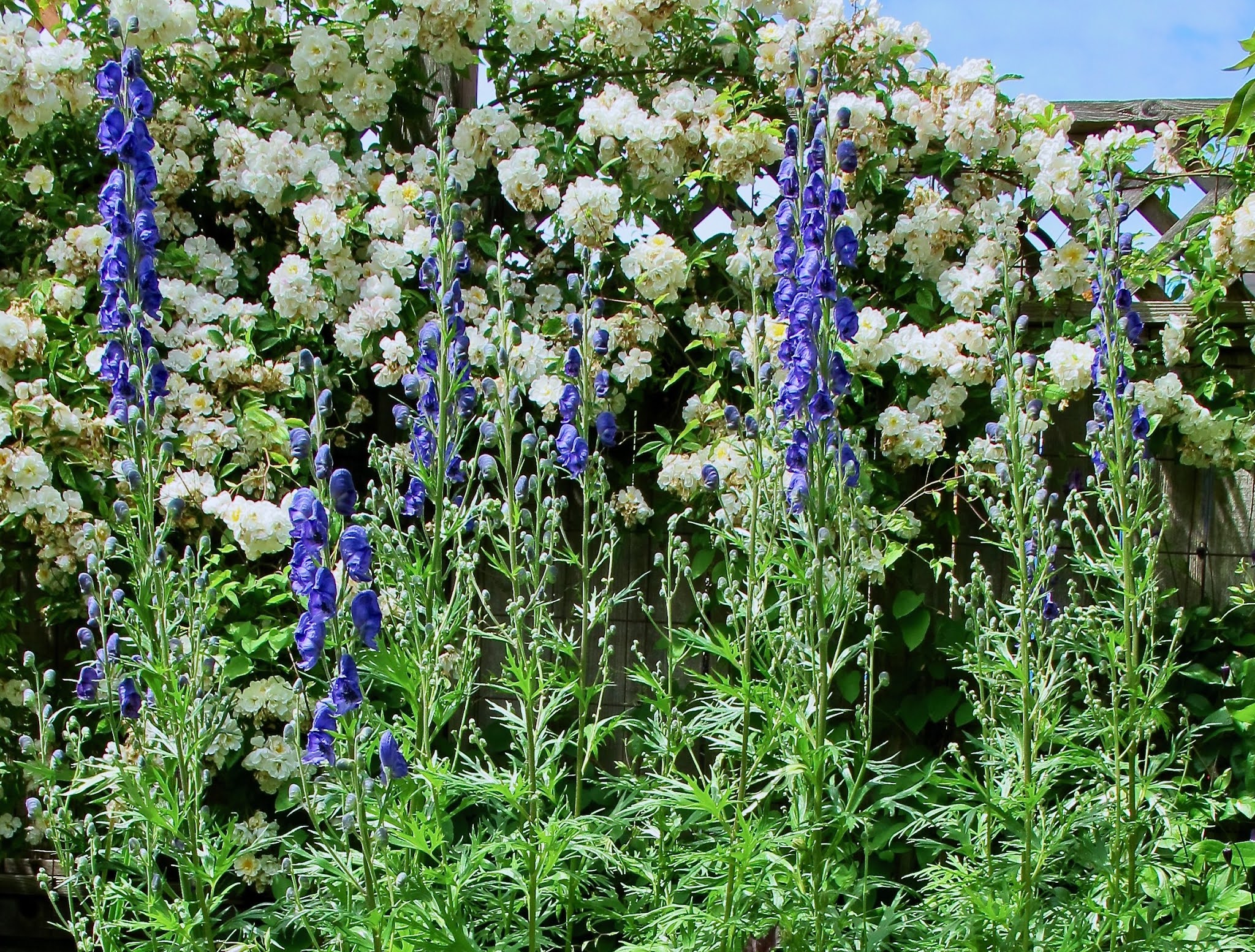
Rosa 'Lykkefund' prefers bright sunshine. Every year it extends its reach along the west fence, casting its powerful scent across the whole garden on warm summer evenings.  Huge trusses of flowers cascade down behind whatever is blooming below. Here they are providing a backdrop to a stand of electric blue aconites.


Although the effect is of a white curtain, a close inspection of individual flowers shows them to have  golden stamens and pale salmon-pink buds.


Across the garden on the east fence, Clematis 'Huldine' also provides a curtain of white. Like the rose its buds are deceptive, being striped in two shades of pink, but as the flowers open to show only their upper surfaces, they glisten satin-white in the sunshine.


Also enjoying the sun is Stewartia pseudocamellia. It's easy to see how this tall slender tree got the pseudocamellia part of its name as soon as it flowers. Some people call it poached egg tree but I feel that doesn't do justice to the elegant fringed white flowers that do indeed imitate camellias.


Giant clover (Trifolium ochroleucum) grows beneath it and flowers at the same time. It's a bit of a stretch to call it white since the flowers are partly green and the petals quite quickly turn to cream but for a little while it fits the description.


It is makes a sturdy clump that needs dividing every few years, but is not at all invasive like some of its cousins. 

The same can't be said of Eryngium giganteum, the giant thistle better known as Miss Willmott's Ghost. This biennial plant is inclined to seed itself around, and small offspring have to be pulled out before their tenacious tap roots get too strong a grip. Nevertheless, it is a beautiful sight in flower, perhaps more silver and green than white.


Harvested and allowed to dry naturally, the flowers make excellent additions to dried flower arrangements, slowly turning the colour of old linen.


Summer Whites

 Gardens are rich in many different colours during the summer months, but just to continue the colour theme I started in April, I'm going to focus on white for this post. 

Ranuculus aconitifolius 'Flore Pleno'is a long name for a small button of a flower. What it lacks in individual size, however, it makes up for in generosity of blooms.

Although it is a member of the buttercup family, it doesn't run. I have two plants side by side each making a sturdy clump that remains quite narrow at the base while spreading twice as wide at the top to make a cloud of bloom. I find that quite a few white flowers turn an unattractive pink as they age, but this perennial stays fresh-looking right until it starts to die. Various sources recommend it for boggy areas and it could probably use more water than it gets in my garden, but it doesn't seem to mind.

Brightening the shade garden in late June, Gillenia trifoliata spreads its constellation of dainty white stars over its lower neighbours. Reddish stems and calyces only heighten its pristine effect. It was a surprise to learn that it's a member of the rose family.

By the end of July it will have completed its bloom cycle and be overpowered in its turn by  the dark leaves of Actea 'Hillside Black Beauty' and the pleated green ones of Hosta 'Krossa Regal'.

Also enjoying the shade is Astrantia major, whose flowers have a more substantial presence. The stamens start out pink but gradually turn greenish-white like the central flower in this cluster. 

This particular plant is self-sown as the Astrantia family is inclined to do, but plants that will flower in dark corners are not common and its easy to edit out unwanted seedlings.

Another shade lover is my tree hydrangea (Hydrangea aspera ssp. sargentiana) Its flowers are actually the tiny purple dots in the centre, but I'm including it here for the fringe of pristine white bracts that give each bloom the look of an exploding firework.

Rosa 'Lykkefund' prefers bright sunshine. Every year it extends its reach along the west fence, casting its powerful scent across the whole garden on warm summer evenings.  Huge trusses of flowers cascade down behind whatever is blooming below. Here they are providing a backdrop to a stand of electric blue aconites.


Although the effect is of a white curtain, a close inspection of individual flowers shows them to have  golden stamens and pale salmon-pink buds.


Across the garden on the east fence, Clematis 'Huldine' also provides a curtain of white. Like the rose its buds are deceptive, being striped in two shades of pink, but as the flowers open to show only their upper surfaces, they glisten satin-white in the sunshine.


Also enjoying the sun is Stewartia pseudocamellia. It's easy to see how this tall slender tree got the pseudocamellia part of its name as soon as it flowers. Some people call it poached egg tree but I feel that doesn't do justice to the elegant fringed white flowers that do indeed imitate camellias.


Giant clover (Trifolium ochroleucum) grows beneath it and flowers at the same time. It's a bit of a stretch to call it white since the flowers are partly green and the petals quite quickly turn to cream but for a little while it fits the description.


It is makes a sturdy clump that needs dividing every few years, but is not at all invasive like some of its cousins. 

The same can't be said of Eryngium giganteum, the giant thistle better known as Miss Willmott's Ghost. This biennial plant is inclined to seed itself around, and small offspring have to be pulled out before their tenacious tap roots get too strong a grip. Nevertheless, it is a beautiful sight in flower, perhaps more silver and green than white.


Harvested and allowed to dry naturally, the flowers make excellent additions to dried flower arrangements, slowly turning the colour of old linen.


Saturday, 12 June 2021

MAYTIME BLUES

 If April is yellow, then May is blue - at least, it is in my garden.

One of the most vibrant blues comes from Geranium 'Terre Franche', whose wiry flower stems rise above a compact clump of contrasting green foliage.


Close by, spikes of Salvia officinalis, the familiar kitchen sage, bloom in similar colours but contrasting shape.


It may not be quite as attractive to me as the geranium, but it is certainly more so to the bees that bustle around it. A single hummingbird is another daily visitor. This year both the sage and the geranium have been particularly luxuriant and I've had to pin them from back from competing to block the narrow path that divides them.

Iris pallida 'Variegata' is worth having for just for its decorative leaves, and becomes even more dramatic when its blue flowers open.


 It's now such a large clump that I'm making a note to divide it this winter. The only problem is going to be where to find space for the extras.

To the left of it, a quite different iris, less showy but to my eyes more elegant, is sending slim spears of flowers up behind our little water feature. It came to me unnamed but I think it is Iris sibirica 'Shaker's Prayer'. That's a lovely name so until I hear otherwise that's what I'm calling it.


I have three clumps of it that, with the bamboo screening behind, give a slightly Japanese air to this corner of the garden. It's a shy bloomer for me because it's in shade for at least half a day. Ideally it would like more sun.

A bolder combination occupies a dominant position in the middle of the garden. The lime-tinted leaves of oakleaf hydrangea 'Sikes Dwarf' look as if they have suddenly sprouted large cobalt-blue flowers. 

In fact, these blooms belong to Clematis x durandii which is planted underneath. This clematis lacks the clinging tendrils of most vining clematis and needs a host like the hydrangea to scramble through. The two plants combine so well that visitors are occasionally fooled into thinking it a single plant.

Ajuga reptans has the mystifying common name of Bugle. A vigorous spreader, it's perfect for my sidewalk garden, which is home to various plants too enthusiastic for the main garden. 

Anything that will survive in these dry beds, infested by roots from the street maple, is welcome here.

There are few plants that will cope with all-day shade but one that seems unfazed is Corydalis temulifolia 'Chocolate Stars'. Its pale blue tubular flowers are floppy, but they brighten a gloomy corner on the north side of the house. 

By the time it blooms, the foliage is a tender green so you might wonder at the name. However, the reason for it is not so much the flowers but the emerging foliage, which I've celebrated in an earlier post.

 
It used to be called Corydalis quantmeyeriana and is still occasionally sold under that name, but this is a rare instance where the nomenclature experts have given us a shorter, more pronounceable name than the old one.

A last contender in the blue range is ice-blue Amsonia hubrichtii

It's unusual to find flowers this pale and it needs a suitable companion not to look washed out, so I'm happy to find it a good companion for the muted pink flowers of Astrantia 'Roma'. 

In the fall, the Amsonia's feathery leaves will turn golden, making it a really good two-season addition to the garden.