Tuesday, 4 February 2020

The Garden Wakes Up.. and Sleeps Again

February began with such promise.
All the winter aconites opened in a brief spell of sunshine.


The first hellebores also leapt into bloom. 'Cherry Blossom' is not only among the earliest, but also one of the strongest and most prolific.

Helleborus 'Cherry Blossom'

'Rachel', another sturdy performer, has to cope with being in the much shadier north-facing garden at the front of the house, but is never far behind.

Helleborus 'Rachel'

The sun also coaxed a few daffodils out. 'Rijnveld's Early Sensation' is a classic yellow that wouldn't be very sensational at all except that it really does live up to the early part of its name and flowers a good month before most of its family.


In the background, a first snowdrop is trying to compete but a few clumps of doubles have beaten it to the punch. It's a pity that you can't tell that they are double unless you put a finger under their chin and tip their faces up.


However, as I write all that encouraging promise of spring has been blotted out, at least for now. Today has brought a fresh spell of snow, so soft and damp that the garden looks as if it's been sprayed with fire retardant.


Wednesday, 22 January 2020

New Year's Resolution

The last several months of 2019 were a busy time for me and so, although I took photos as the garden moved from the bright colours of summer into the jewel tones of fall, I never found the time to post them.
My resolution for 2020 is to keep this record going with at least one post every month. We shall see.

A heavy snowfall to start the year off left little to see.


Still, I was surprised at how well the oak leaf hydrangea weathered its load, considering that it hadn't dropped its autumn leaves. Their russet tints made a nice contrast with their caps of snow at a time when any colour at all is welcome.


Of course, the snow only enhanced structural plants like our ancient pear.


Without the snow, its coating of lime-green moss and blue-grey lichen continues to keep it attractive, particularly to birds like juncos and chickadees who pick their way through the branches in search of edible tidbits.


My homemade chickadee nesting box on the trunk has only once been occupied in five years, but I put it out every winter in hopes of new residents.

Along the front of the house, we piled snow from the sidewalk against the bottom of the lavender hedge to try to support the somewhat brittle stems. They will need an additional pruning this spring to bring them back to a compact shape.


Rather to my surprise, the stems of Sedum 'Autumn Joy' in the bed behind the lavender are demonstrating an unsuspected sturdiness. This is such a good plant for year-round value. Here it is last fall with leaves turning yellow and flowers deepening from sultry pink to dark crimson.


The flowers are a rich brown now, nothing special at any other time of year but a pleasing contrast to so much winter grey and white.

Fortunately, the weather has warmed in the last few days and the snow has melted rapidly to reveal signs of spring already. Winter aconites (Eranthis hyemalis) are always first to bloom, ahead of even the snowdrops. This is not really surprising once you know that "hyemalis" means "of winter". (When I studied Latin in school, I had no idea what an asset it would be to me as a gardener later in life.)


There are buds on most of the hellebores too, though H. 'Jacob', the only one that has opened so far, has been stripped of every bloom by slugs. Still there are other, more resistant ones on the verge of flowering, like 'Pink Frost' and a plant that I bought, sad and unlabelled in a big box store clearance, that is responding well to better conditions. I think might be 'Jade Tiger'.

Hellebore 'Pink Frost'


Hellebore 'Jade Tiger'?

Perhaps the most consistently satisfying plant in this gloomy season has been Mahonia 'Winter Sun'.
When it first began to bloom in late October, my 'Lykkefund' rose was wreathing it in festive red berries.


The flowers are falling now, but it's still a cheerful sight and still draws an occasional hummingbird to siphon off the last of its nectar.


Friday, 16 August 2019

The Highlights of Summer

Now that the garden is approaching maturity, I find I have less to write about that I haven't covered in previous years. As a result, I'm only now gathering a few images from the last months that have struck me as worth a second, or even a third, look.

I've always enjoyed the brief but glamorous display of an unnamed red peony that predates our arrival. I moved it a few years back into more sun and more recently planted two Ranunculus 'Flore Pleno' beside it. The contrasting forms and colours made it a winning combination in late May.


Even after the peony was spent, the little white buttons of the Ranunculus kept on sparkling well into June.

A new bulb for me this year was Allium atropurpureum, actually darker than it looks in my photo. I've planted it around Salix lapponum, whose silver foliage sets off the wine-red flowers. I like the effect enough to plan on buying more of it.


Disporum 'Night Heron' was too small and innocuous to make much of an impact last year, but this year it has grown to more than a metre. It's a subtle addition to the shady back of the garden, but the  the drooping cream bells and unusual pleated leaves with their inky overtones are worth lingering to appreciate.


Anemone 'Wild Swan' goes from strength to strength. The crisp white face of the flowers brings a reminder of spring into the middle of summer, and the surprise of their lavender reverse is a nice bonus.


It seems to remain compact where it has more space and stretches readily to compete with other perennials when they crowd in around it. Here it's competing with a blue monkshood, purple Monarda 'Donnerwolke' and the dark brown leaves of self-seeding Angelica gigas 'Vicar's Mead'


Clematis 'Durandii' has never been better than this year. The buds looked like little snakeheads as they threaded their way through my oak leaf hydrangea,


... and the flower display was spectacular.


Tucked away in the shade, Roscoea cautleyoides 'Alba' has only produced a single flower stem in the several years I've had it, but it too has rewarded me this year with several of its strange, fragile flowers. It disappears so completely in winter that I have to mark its place with the top ring of a broken clay pot or I'm likely to trample it to death during early spring clean-up.


A year cannot go by without a mention of the roses. Their flowers opened early, before the end of May, and they faded quickly, but what they lacked in longevity they made up for in wealth of bloom.

Rosa pimpinellifolia
'Lykkefund'
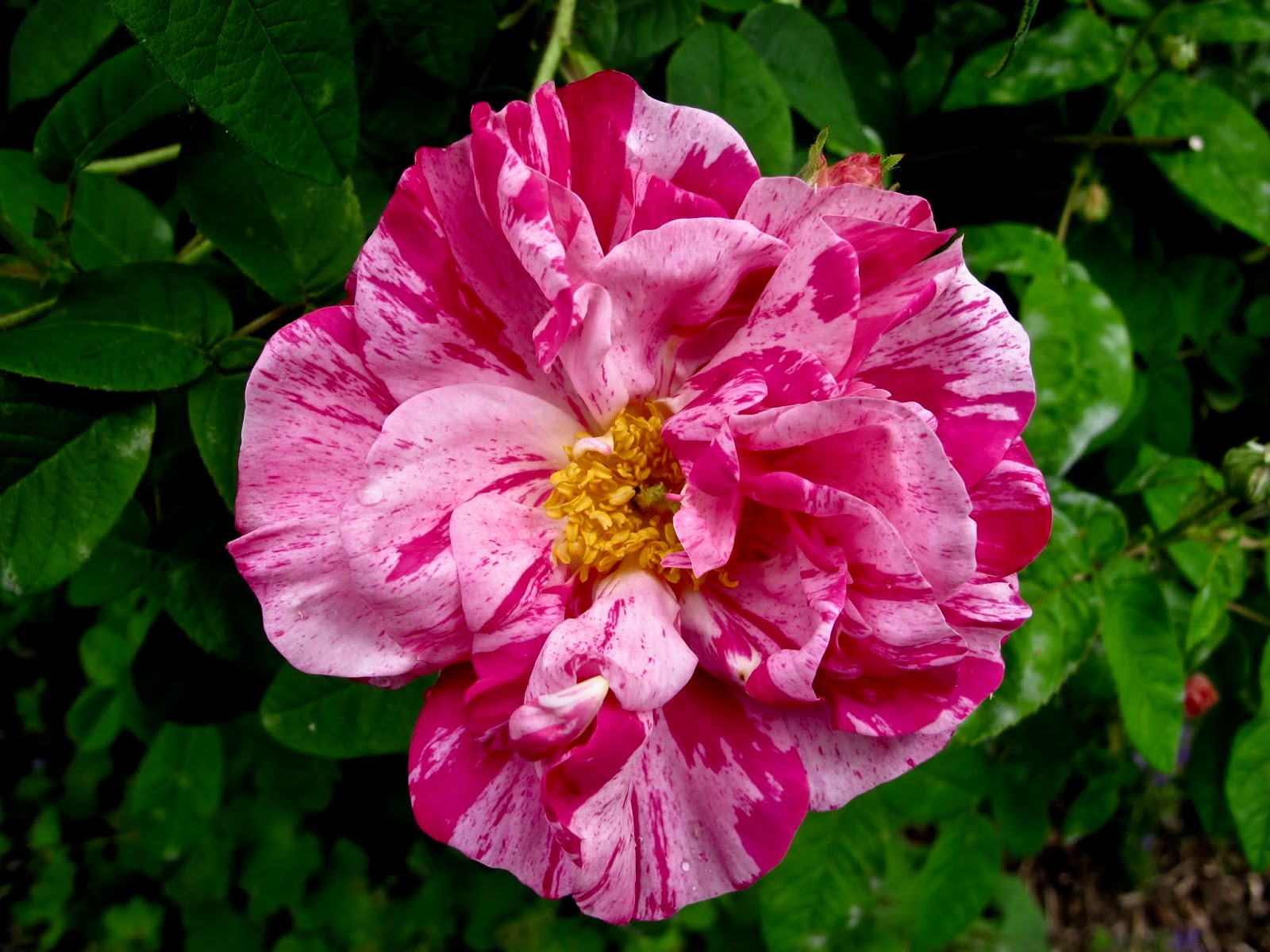
'Rosa Mundi'
'Ghislaine de Féligonde'

A special mention this year for Rosa 'Bill Forsyth', named by me for the man who bred it and who gave me a plant that I later passed on to Free Spirit Nursery, who gave me back a young specimen this year. It has the blue-grey foliage of its parent Rosa glauca, but a larger, more vibrant pink flower. Bill is no longer with us, but I hope his rose will keep alive the memory of a quiet, modest man whose gardening skills and knowledge were legendary among those of us who value such things.

'Bill Forsyth'

Saturday, 1 June 2019

Sliding into May

What happened to April? All growth was on hold, as the unusually warm weather of March returned to cooler temperatures.  Exceptions were the old pear tree,


 and the espaliered apples.


We've long since given up expecting anything edible from the pear, but we keep it for the structure it gives to the garden. The apples, on the other hand, gave us a basket full of fruit last year and look set to do the same this year.,

Once May began, everything moved ahead once more. In the front garden, Royal Azalea (Rhododendron schlippenbachii, for those who like a tongue-twister) opened its candy floss pink flowers that team so nicely with the crisp green foliage.


Shortly after, came the Ballerina tulips.  I'm not a big fan of orange, but these sultry beauties are so elegant on  their tall stems and blend so well with the surrounding greenery that I keep buying more.


Now I have a young Enkianthus 'Red Bells' to keep them company.


The flowers on both come later than the azalea and die away before they can clash with some other soft pink shades that follow on the surrounding plants.
Across the sidewalk a few plants in my boulevard beds are doing better than expected. Centaurea 'Amethyst in Snow' is possibly going to get too vigorous as it loves the dry, poor soil there.


Meanwhile on the other side of the house, shade-lovers are demanding attention in their subtle way. Arisaema ringens is outgrowing its pot, but still managing a good show. 


You can see where I've cut away a few leaves so that the curious flowers are easier to see.
Close beside it is Disporum 'Night Heron', which is now tall enough to be noticeable. It's a graceful plant, surprisingly striking with its contrast of small, pale green flowers and dark-stained foliage.


At the right side of that image are more dark leaves on Hydrangea 'Kumasaka'.


And further along, the buds of Allium siculum rising through the speckled leaves of Podophyllum 'Spotty Dotty' complete the green and purple composition.


Hosta 'American Halo' under the pear tree is unfurling too. Its leaves bring an echo of pale sunshine to another shady area. 


 The other excitement of May was the appearance of a raccoon in broad daylight, making her way through the garden from front to back several times. I managed a blurry photo of her on one of her return journeys through the next door yard.


We realized that she was transferring her babies away from the house across the street, having a sixth sense of what was about to happen there.


Thursday, 16 May 2019

March Marches In

March was such an unusually warm and sunny month that I couldn't chain myself to the computer to record the awakening of the early perennials, so here I am doing it in May.

Corylopsis pauciflora is always reliable and a much more graceful harbinger of spring than the ubiquitous Forsythia


In the shade at its feet, barely visible as a dark blur in the above photo, is Hellebore 'Harlequin Gem', now starting to become a substantial plant. Its inky blooms contrast well with the Corylopsis above it.


Of course, many of the hellebores were pushing through the last of the snow in February. Since I've recorded them in detail in previous years, I'm just going to add one more this time.
'Peppermint Ice' is always an eye catcher.


 This year a white self-sown seedling has bloomed beside it and I like the contrast.


Meanwhile, across the garden Salix gracilistyla 'Melanocarpa' is flourishing.


'Melanocarpa' means black berry but it's the young catkins that are black (with red tips.) As they age they turn, like many of us, to silver-grey. Both stages contrast well with the reddish stems.

Narcissus 'Jack Snipe' has now taken over  from 'Rijnveld's Early Sensation' ".  The flowers are pretty and shapely but it's beginning to be more work, as it multiplies fast and the clumps are getting too large for their allotted space.


Added to that, the foliage hangs around afterwards looking increasingly shabby, and you can't cut it back because it's feeding next year's flowers. Last year I tried my usual trick of planting a perennial that will emerge and screen the collapsing leaves, but so far it's not working: the perennial I chose is still dormant!
Time for a re-think.

Tuesday, 19 February 2019

February Snow

After two weeks of warm sunshine and blue skies in Mexico, it was a shock to return to snow in Vancouver, even though it did look pretty.

 By mid-February I'm normally enjoying the display of small bulbs like snowdrops, snow crocus and winter aconites, but of course they are all buried.

There's one exception. The ever-reliable Narcissus 'Rijnveld's Early Sensation' is living up to its name and boldly pushing its cheerful yellow flowers up through the sugary crust, reminding me to order more and spread them around to enjoy at this low point in the year.